
A Fixed Solution for a Full Arch of Missing Teeth
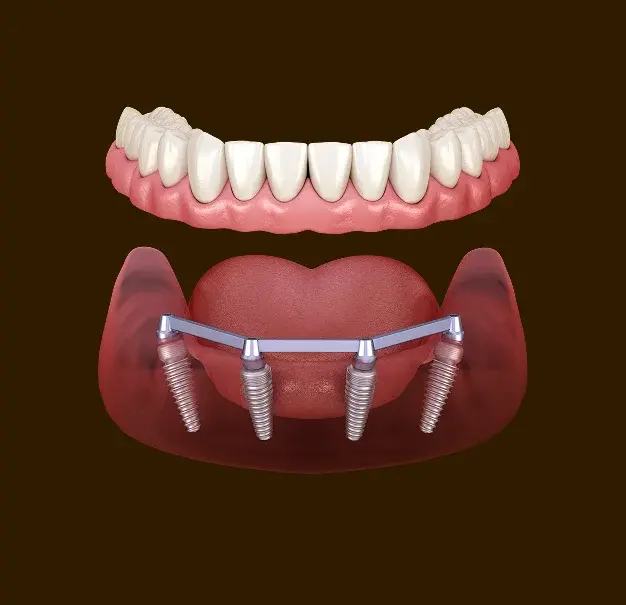
Losing most or all of the teeth in an arch, whether from decay, gum disease, or years of wear, changes far more than the way a smile looks. Chewing becomes difficult, the jawbone begins to lose density without teeth to stimulate it, and the lower face can start to look sunken over time. All-on-4 dental implants address this by replacing an entire arch of teeth with a fixed, nonremovable denture supported by just four implants strategically placed in the jawbone.
At Belmont Dentistry in Scottsdale, the All-on-4 approach gives patients a permanent, natural-looking set of teeth without the bulk, adhesives, or slipping that come with traditional dentures.
Signs Full Arch Replacement Might Be the Right Solution
Several situations point toward All-on-4 being worth exploring as an option, and a consultation can confirm whether it is the right fit.
- Most or all of the teeth in an arch are missing, failing, or beyond saving
- A removable denture that slips, clicks, or feels uncomfortable during normal use
- Significant bone loss that has made individual implants difficult to place
- A desire for a permanent, fixed alternative to removable dentures
- Ongoing difficulty chewing a full range of foods comfortably
How Four Implants Support an Entire Arch
All-on-4 implants get their name from the four titanium implants used to support each arch of replacement teeth. Two implants are placed vertically toward the front of the jaw, where bone density is typically strongest, and two are placed at an angle further back, which allows them to engage more of the available bone without needing a bone graft in most cases. This layout spreads chewing forces evenly across the arch and creates a stable foundation sturdy enough to support a full fixed denture attached the same day the implants are placed.
The All-on-4 Treatment Process
Because All-on-4 replaces an entire arch in one coordinated treatment, the process is planned carefully from the very first visit through to the final denture.

Comprehensive Consultation and Imaging – A 3D CT scan maps the jawbone in detail, showing exactly how much bone is available and where the implants can be placed most effectively.
Personalized Treatment Planning – The scan is used to design a digital plan that maps the precise position and angle of each of the four implants before surgery ever begins.
Removing Any Remaining Teeth – Failing or unhealthy teeth still present in the arch are removed during the same visit as implant placement, when needed.
Placing the Four Implants – The implants are positioned in the jawbone according to the treatment plan, with the two back implants angled to maximize contact with available bone.
Attaching a Temporary Fixed Denture – A temporary but fully fixed denture is attached to the implants the same day, so patients leave with a full set of teeth rather than an empty arch.
Healing and Fitting the Final Denture – After several months of healing, once the implants have fully integrated with the bone, a custom final denture replaces the temporary one.
What Healing Feels Like in the Weeks After Surgery
Some swelling and mild discomfort are normal for the first several days after surgery, and prescribed or over-the-counter pain relief typically keeps this manageable. A soft food diet is recommended while the surgical sites heal and the implants begin to integrate with the jawbone, gradually returning to a normal diet as healing progresses. The temporary denture is designed to be worn throughout this period, so daily life continues with a full smile in place while the implants heal beneath the surface.
Life with a Full Arch of Fixed Teeth
Once healing is complete, a full arch of All-on-4 implants functions much like a natural set of teeth, with no need to remove anything at night or use adhesives to keep it in place. Most patients find they can eat a much wider range of foods than they could with a removable denture, since the fixed denture does not shift or loosen while chewing.
Daily care is straightforward and mainly involves brushing and cleaning around the implants the way recommended at each visit, along with regular checkups to keep the entire arch healthy long-term.
Ready to Replace a Full Arch with a Permanent Solution?
A full arch of missing or failing teeth does not have to mean a lifetime of removable dentures. Reach out to the Scottsdale office to find out if All-on-4 implants are the right solution for your smile.
Frequently Asked Questions
About All-on-4 Implants
The implant placement and temporary denture are typically completed in a single day, though the full process, including healing and the final denture, usually spans four to six months
The surgery itself is performed under anesthesia, so patients do not feel pain during placement. Mild soreness and swelling afterward are normal and typically manageable with pain relief for the first several days.
No. A temporary fixed denture is attached to the implants on the same day as surgery, so patients leave with a full set of teeth throughout the healing period.
All-on-4 is fixed in place and does not come out for cleaning or sleeping, unlike a traditional denture. Because it is anchored to implants rather than resting on the gums, it also does not shift, click, or require adhesive during normal use.
Many patients who have been told they lack enough bone for traditional implants are still candidates for All-on-4, since the angled back implants are specifically designed to make use of available bone without a graft. A consultation at Belmont Dentistry can confirm candidacy with imaging.
The fixed denture is cleaned similarly to natural teeth, using a brush and a water flosser or similar tool to clean underneath and around the implants. Regular checkups allow the team to check areas that are harder to reach at home.
Coverage varies widely by plan, and many dental insurance plans offer only partial coverage for implant-supported dentures. Our Scottsdale office can help review your specific benefits before treatment begins.
A soft food diet is recommended for the first several weeks while the implants heal, with a gradual return to firmer foods as healing progresses. Most patients in Scottsdale are back to a full, normal diet within a few months once the final denture is placed.